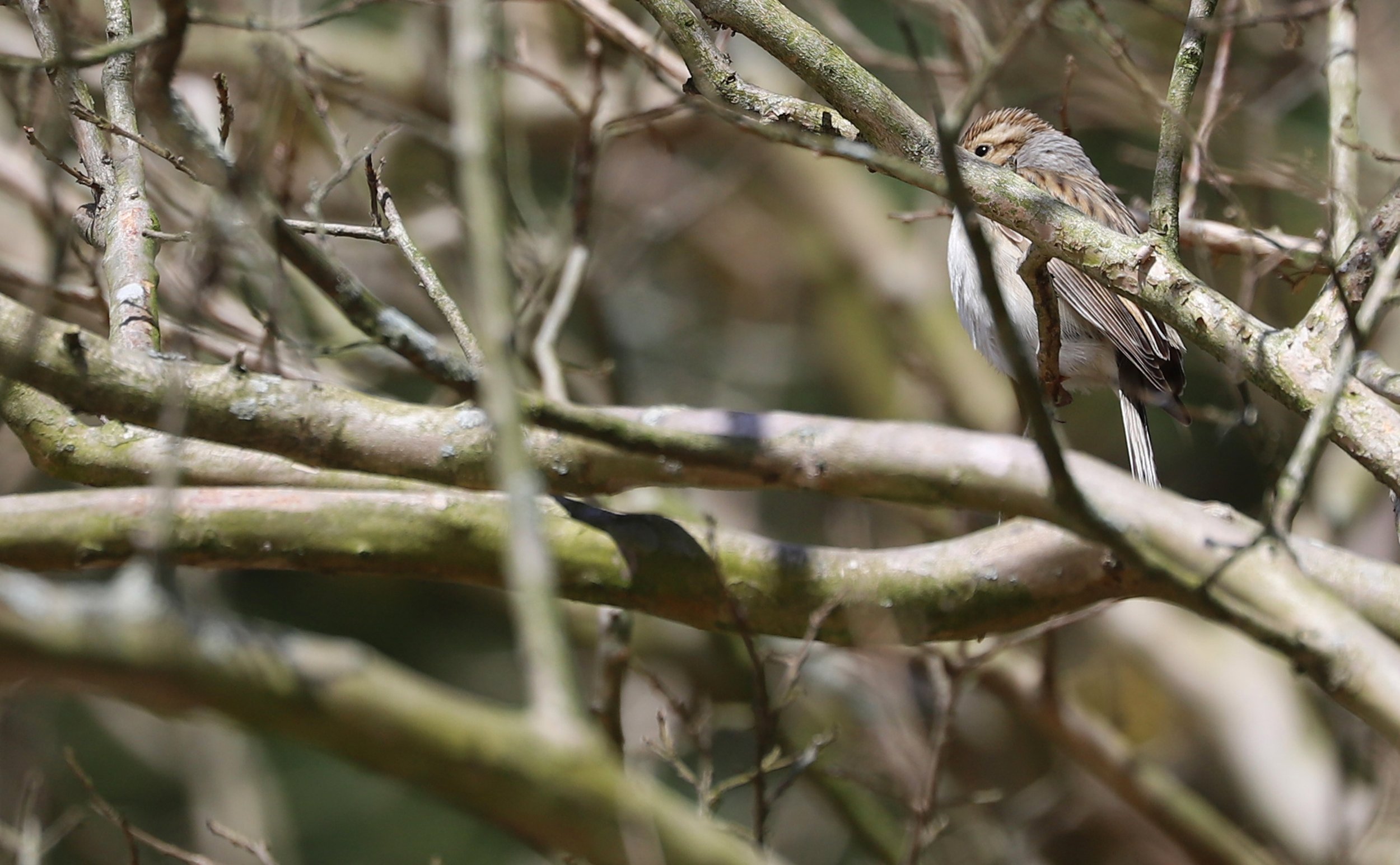
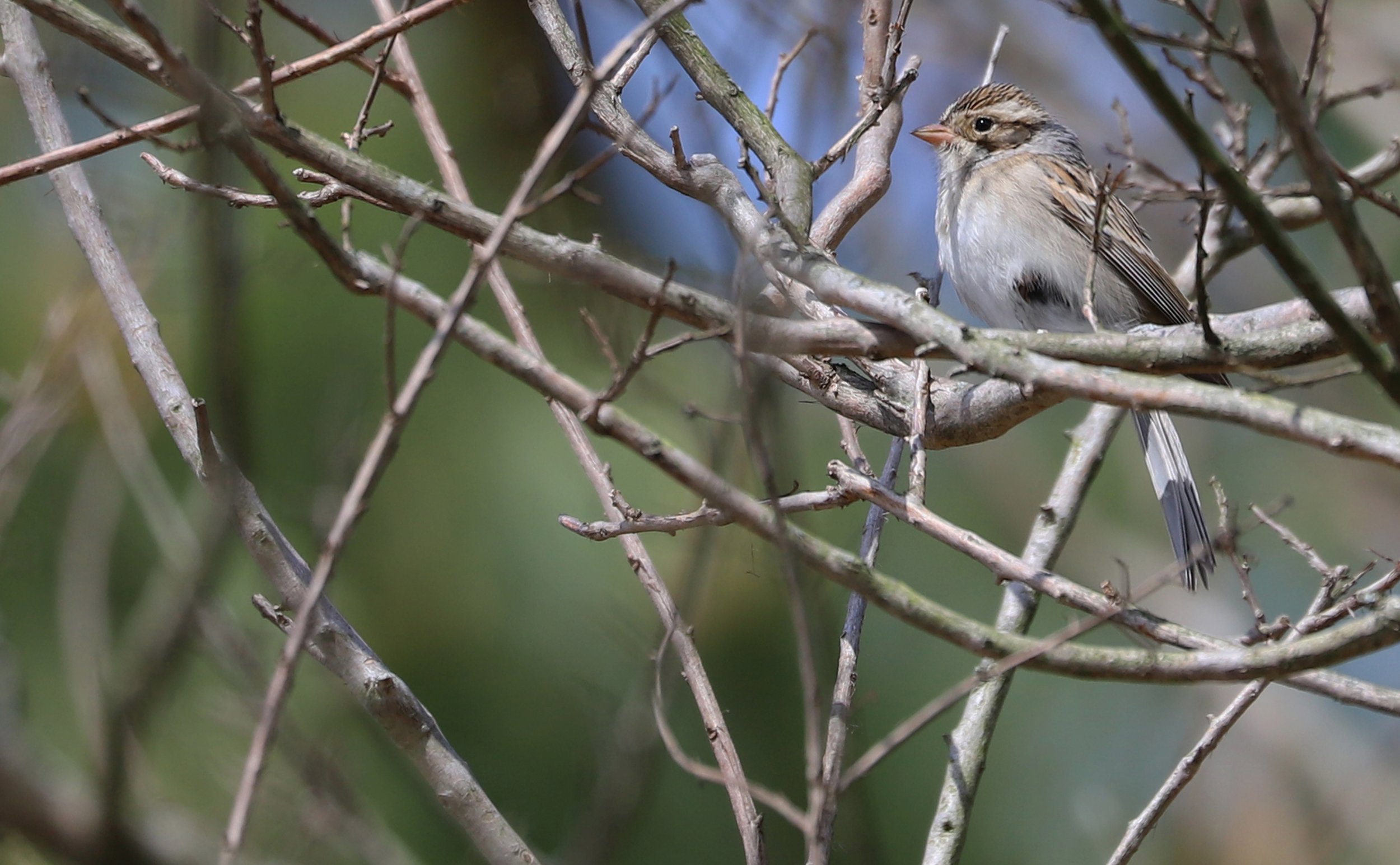
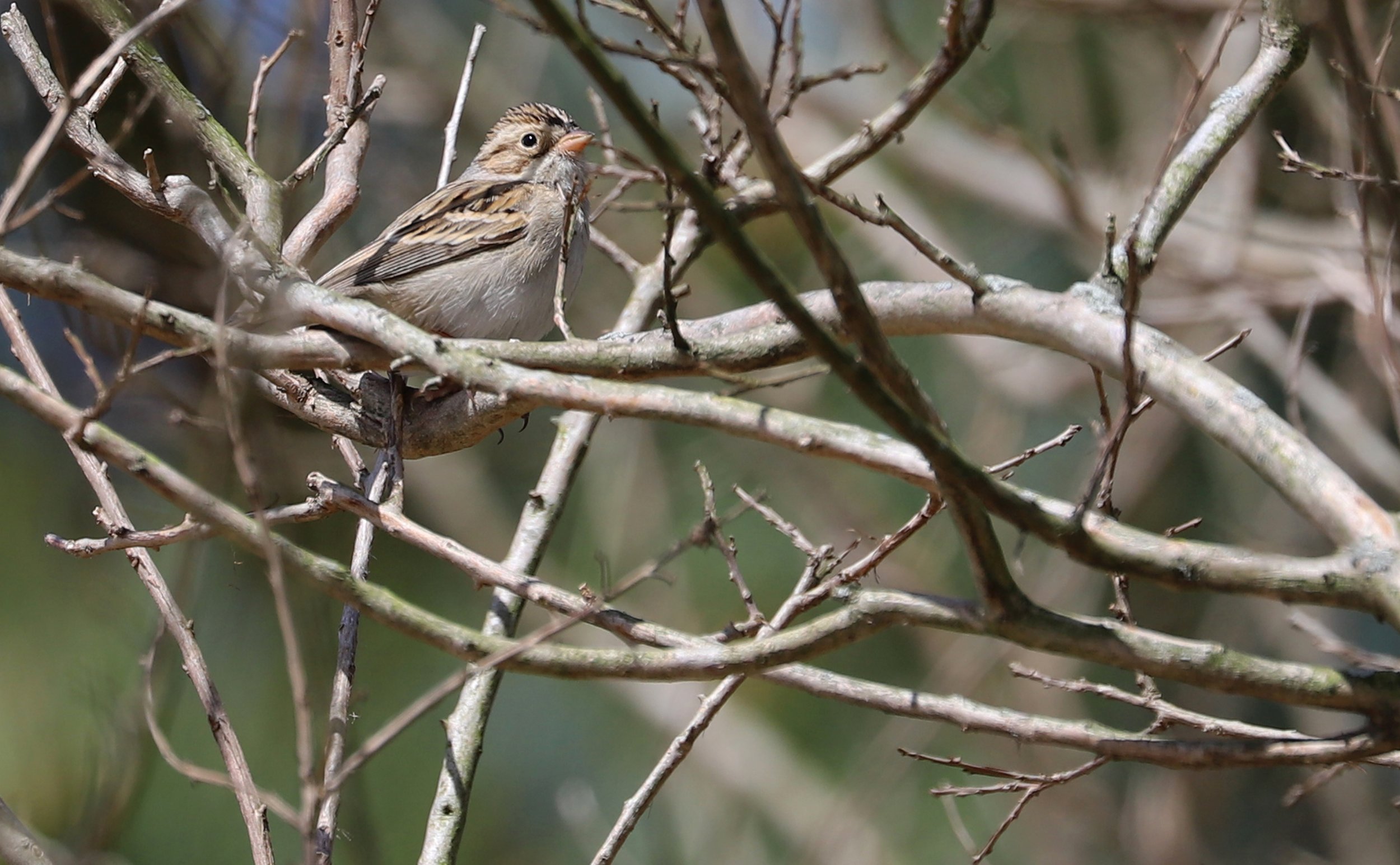
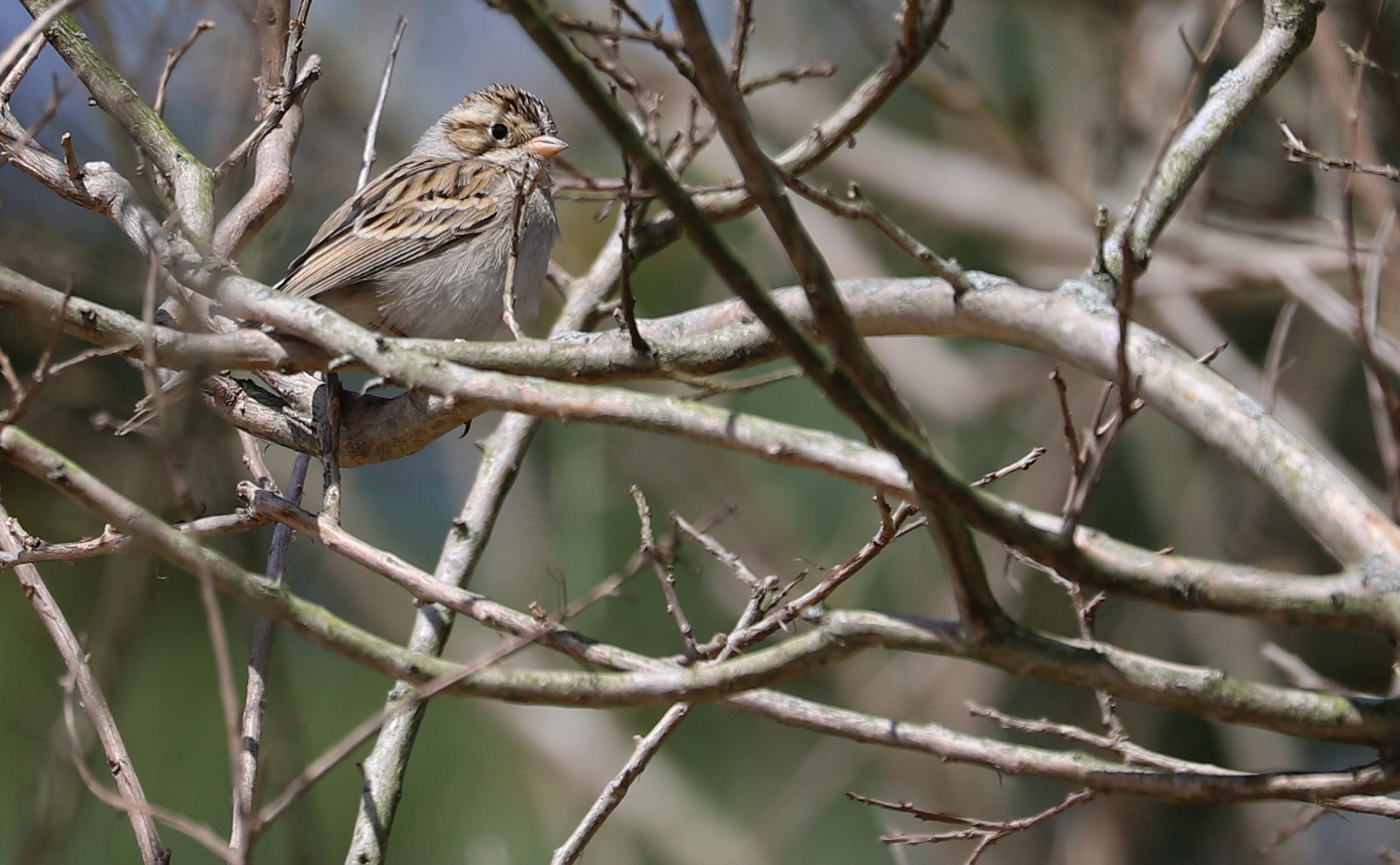
An over-wintering Clay-colored Sparrow at the Chesapeake Arboretum
/On Saturday, 11 Mar 2023, after spending the morning at the Great Dismal Swamp and nearby lands in southwest Chesapeake, I swung by the Chesapeake Arboretum to follow-up on the recent records of an adult male Painted Bunting lingering around the parking area (probably visiting feeder setups in the adjacent residential lots). By this point in the day, the winds were roaring out of the northwest, probably around 20 mph, so hearing was quite difficult and picking out subtle movements of passerines among the wind-whipped vegetation was even tougher. After a considerable amount of pishing, eventually several House Finches caught my attention in the line of shrubs along the north edge of the gravel parking lot immediately west of Oak Grove Road, so I spent a bit more time searching this area to see if other songbirds might fly in to the raspy sounds. Slowly but surely, a few more birds came in to investigate. I’d seen a Chipping Sparrow, a Dark-eyed Junco, a stray Yellow-rumped Warbler, but no brilliantly colored male Painted Buntings flew in to view.
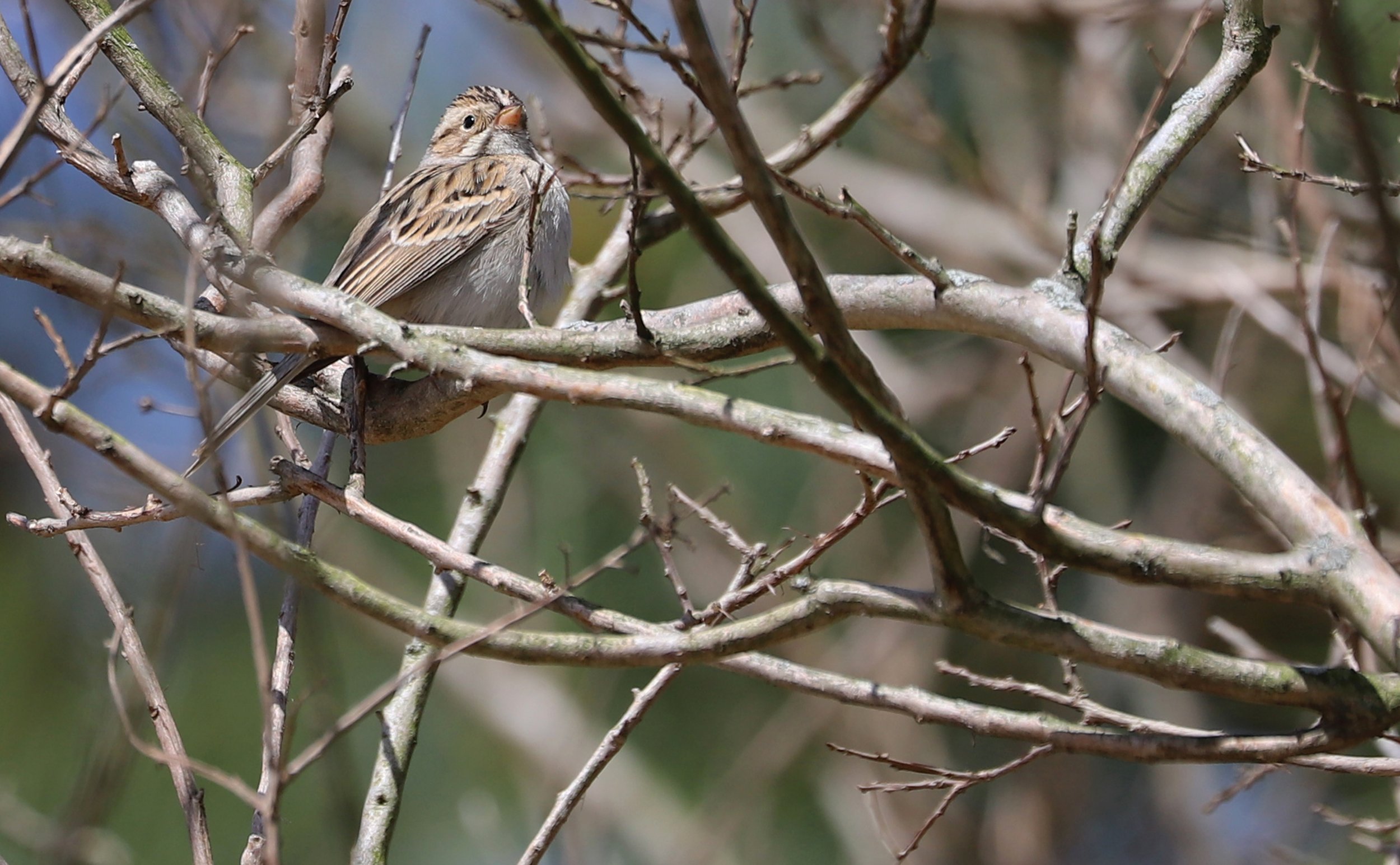
Then suddenly, at 11:21 AM, an unexpected CLAY-COLORED SPARROW popped up into view briefly before moving higher into a medium-height tree along the fence line, maybe 100 feet back (west) from the roadway. Even at a quick glance (mostly just the head was visible initially), this individual was readily identifiable by its beautiful features which included a consistently light gray colored & unstreaked nape, small pink bill, vivid white malar / moustachial stripe with brown edging, and lack of eye line extension forward of the eye giving the lore a ‘softer’ appearance than the somewhat similar Chipping Sparrow. Recognizing the unusualness of this species in Chesapeake, especially in early March, I quickly switched from binoculars to camera in an attempt to document the record as best I could. Over the ensuing 4 minutes, I shot a total of 52 photographs (though most were of marginal quality) of the bird before it flew out from the tree, headed southward along the eastern edge of the farmhouse/park office then slipped behind the building out of view. I kept birding the area until 11:51 AM, but I never caught back up with this Clay-colored Sparrow, despite seeing quite a few Chipping Sparrows in the area where it vanished and carefully sorting through those and the other passerines that were foraging among the grass/shrubbery. Fortunately, other birders managed to re-find and document this Clay-colored later in the day (ph. Christina Sabochick) and the following morning (ph. David Gibson), with the last report here occurring 14 Mar 2023 (vis. Paul King).
Clay-colored Sparrow is fortunately a species that most coastal Virginia birders are familiar with, since it is seen fairly regularly during fall migration, though it is still a rare bird here overall. Their peak occurrence in the region tends to be from about mid-September through October, with over-wintering individuals noted more rarely. With this record occurring on 11 Mar 2023, one assumes this bird has probably been at this location (or nearby) throughout the season, since this species doesn’t tend to move back northward this early. I would suggest that any March records in Virginia are safely attributed to over-wintering birds, rather than to early northbound arrivals (especially given the core of their migration movement is through the Great Plains). Thankfully, eBird has made visualizing species distribution and migration patterns much easier, and there’s an excellent week-to-week model located here on their website. If you click the Play button on the right panel and watch the abundance distribution change over time, note that the species begins to move northward from Texas in late March/early April. Technically, April/May records in Virginia could potentially pertain to over-winterers who simply went undetected (known winterers have stayed as late as 3 May for example), but the percentages probably shift a bit towards individuals who wintered south of us and are transiting across the state to get back to proper breeding habitat. To that point, any individuals wintering in coastal North Carolina would likely pass through Virginia en route to the northern prairie states and Canadian prairie provinces. So, it basically comes down to the fact that it is impossible to say where these newfound, late spring individuals may have wintered.
In terms of report frequency, this is only the second documented occurrence for Clay-colored Sparrow in the city of Chesapeake and the third total individual. On 4 Feb 2021, two Clay-colored Sparrows were photographed visiting a residential feeder off Saddlehorn Drive in the North Landing Farms neighborhood (ph. Keith Roberts). Statewide, this is at least the 37th documented record for a wintering Clay-colored Sparrow based solely on eBird reporting. It should be noted that there are almost certainly other past occurrences that simply never made it into the system or weren’t documented well enough to be validated/confirmed into the public database (but may have been correct nonetheless), so one can never really assign a certain value to how many records we’ve had. That said, a comprehensive listing of eBird records for individuals present during the Dec-Mar time frame is included below:
1, Chesapeake Arboretum, Chesapeake, 11-14 Mar 2023 (ph. Rob Bielawski).
1, Bland Experimental Farm / State Arboretum of Virginia, Clarke County, 6 Feb 2023 (ph. David Carr).
1, Botetourt Center at Greenfield, Botetourt County, 18 Nov-4 Dec 2022 (vis. Annie Downing; later ph. Lucy Rowe).
1, Harris Teeter Retention Pond, Virginia Beach, 16 Oct 2022-12 Mar 2023 (ph. Reuben Rohn). *This is the 3rd cycle in a row that an individual has been documented over-wintering at this site.
1, Harris Teeter Retention Pond, Virginia Beach, 25 Mar-8 Apr 2022 (ph. Reuben Rohn). *This is the 2nd cycle in a row that an individual has been documented over-wintering at this site.
2, North Landing Farms (Saddlehorn Drive), 4 Feb 2021 (ph. Keith Roberts).
1, Ocean Lakes (Private Residence), 13-22 Jan 2021 (vis. Brandon Holland).
1, Pughsville North CBC Sector (Nansemond River CBC), Suffolk, 4 Jan 2021 (vis. Robert Ake & Bill Williams).
1, Locust Dale Road, Culpeper County, 31 Dec 2020 (ph. Jason Strickland).
1, Harris Teeter Retention Pond, Virginia Beach, 30 Dec 2020-19 Apr 2021 (ph. Rob Bielawski).
1, Virginia Beach National Golf Club, Virginia Beach, 21-25 Jan 2020 (vis. & later ph. Andrew Baldelli).
1, Indian River (Private Residence), Virginia Beach, 31 Jan 2019 (vis. George Harris & Rosemarie Harris).
1, Curles Neck Farm, Henrico County, 16 Dec 2018-3 Mar 2019 (ph. Jack Esworthy IV & Ellison Orcutt).
1, Shirley Plantation, Charles City County, 16 Dec 2018 (ph. Allen Bryan).
1, Laurel Hill Equestrian Center, Fairfax County, 9 Nov 2018-17 Feb 2019 (vis. Kurt Gaskill; later ph. Jeffrey Pozner). *This is the 2nd cycle in a row that an individual has been documented over-wintering at this site.
1, Pocahontas Club Road, Virginia Beach, 18 Jan 2018 (vis. Andrew Baldelli).
1, Winter Wheat Lane (Private), New Kent County, 31 Dec 2017 (ph. Carson Lambert & Andrew Rapp).
1, Laurel Hill Equestrian Center, Fairfax County, 5 Dec 2017-27 Feb 2018 (ph. Will Kennerley).
1, Exeter Court (Private Residence), James City County, 16 Jan-3 May 2017 (ph. Brian Taber).
1, Curles Neck Farm, Henrico County, 18 Dec 2016 (ph. Ryan Graves & Ellison Orcutt).
2, Seaside Road, Northampton County, 22 Jan 2016 (vis. Edward Brinkley; later ph. Roberta Kellam).
1, Craney Island Dredged Material Management Area, Portsmouth, 21 Jan 2016 (ph. Robert Ake & Bill Williams).
1, Seaside Road, Northampton County, 17-20 Jan 2016 (vis. Todd Day fide Edward Brinkley).
1, US Route 17 at Carr Lane, Fauquier County, 17 Jan 2016 (ph. Ellison Orcutt & Beth Oristian).
1, Blackburn Road, Prince William County, 28 Dec 2014-14 Feb 2015 (vis. Marc Ribaudo; later ph. Elton Morel).
1, Bells Lane, Staunton, 8 Feb-3 Apr 2014 (vis. Diane Lepkowski & Greg Moyers; later ph. David Wendelken).
1, Bristersburg Road at Elk Run Road, Fauquier County, 14 Feb 2014 (vis. Kurt Gaskill).
1, Arlington (Private), Northampton County, 24 Dec 2012 (obs. Edward Brinkley).
1, Lucketts, Loudoun County, 2 Jan 2012 (vis. Elton Morel).
1, Smith Mountain Lake Community Park, 3 Dec 2011 (vis. Kent Davis & Mike Smith).
1, Trader Farm (Private), Westmoreland County, 28 Oct 2007 (vis. Frederick Atwood).
1, Bull Run Regional Park, Fairfax County, 10 Jan 2006 (obs. David Larsen).
1, Rappahannock River Valley NWR (Wilna Tract), Richmond County, 9 Jan 2005 (obs. Allen Bryan; ph. John Fox fide Virginia’s omnium-gatherum).
1, Julie J. Metz Wetlands Bank, Prince William County, 30 Nov 2003-16 Feb 2004 (obs. Larry Meade).
1, Troy Creek Farm (Private), Westmoreland County, 15 Dec 2002 (vis. Frederick Atwood).
1, Greensprings Interpretive Trail, James City County, 20 Jan-6 Apr 2002 (vis. Bill Williams).
1, Mannassas National Battlefield Park, Prince William County, 24 Dec 2001-16 Feb 2002 (vis. Kurt Gaskill).
Lastly, I should probably mention that I never did find the Painted Bunting that brought me here in the first place, but that’s just fine with me. Anyone who knows me, even a little bit, knows sparrows are my favorite group of birds, and in my opinion finding a rare sparrow is about as exciting as birding gets.